There is a good reason for colonizing another planet, which is to avoid extinction
if the Earth is hit by a 10km or larger asteroid, as has happened many times in the Earth's history.
Colonization of Mercury
appears to be a very real and practical possibility, whereas colonization of
Mars or the other planets, moons or asteroids is really more in the realm of fantasy.
The first thought about Mercury is that it would have very high temperatures and no water,
because the equatorial surface temperature ranges between
-183oC and 427oC as the planet rotates.
But an analysis of temperature vs. latitude and depth
shows that the temperature is nearly constant at room temperature (22+/-1oC) in
underground rings circling the planet's poles,
and deeper than .7 meter below the surface. Similar results are found using numerical techniques in an
Icarus paper, Vol. 141, 179–193 (1999).
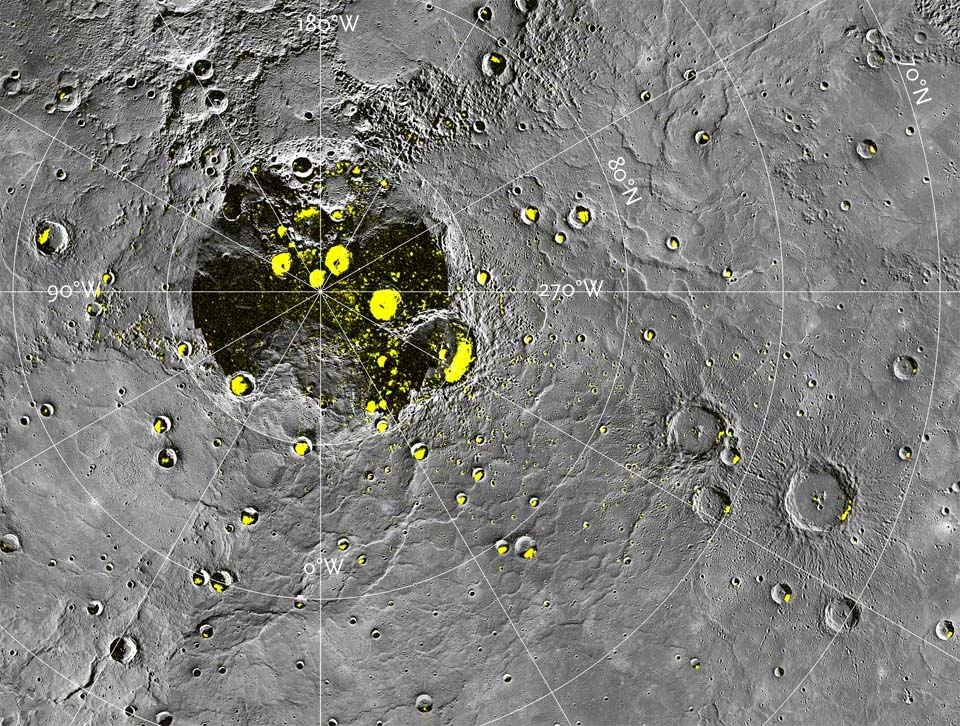
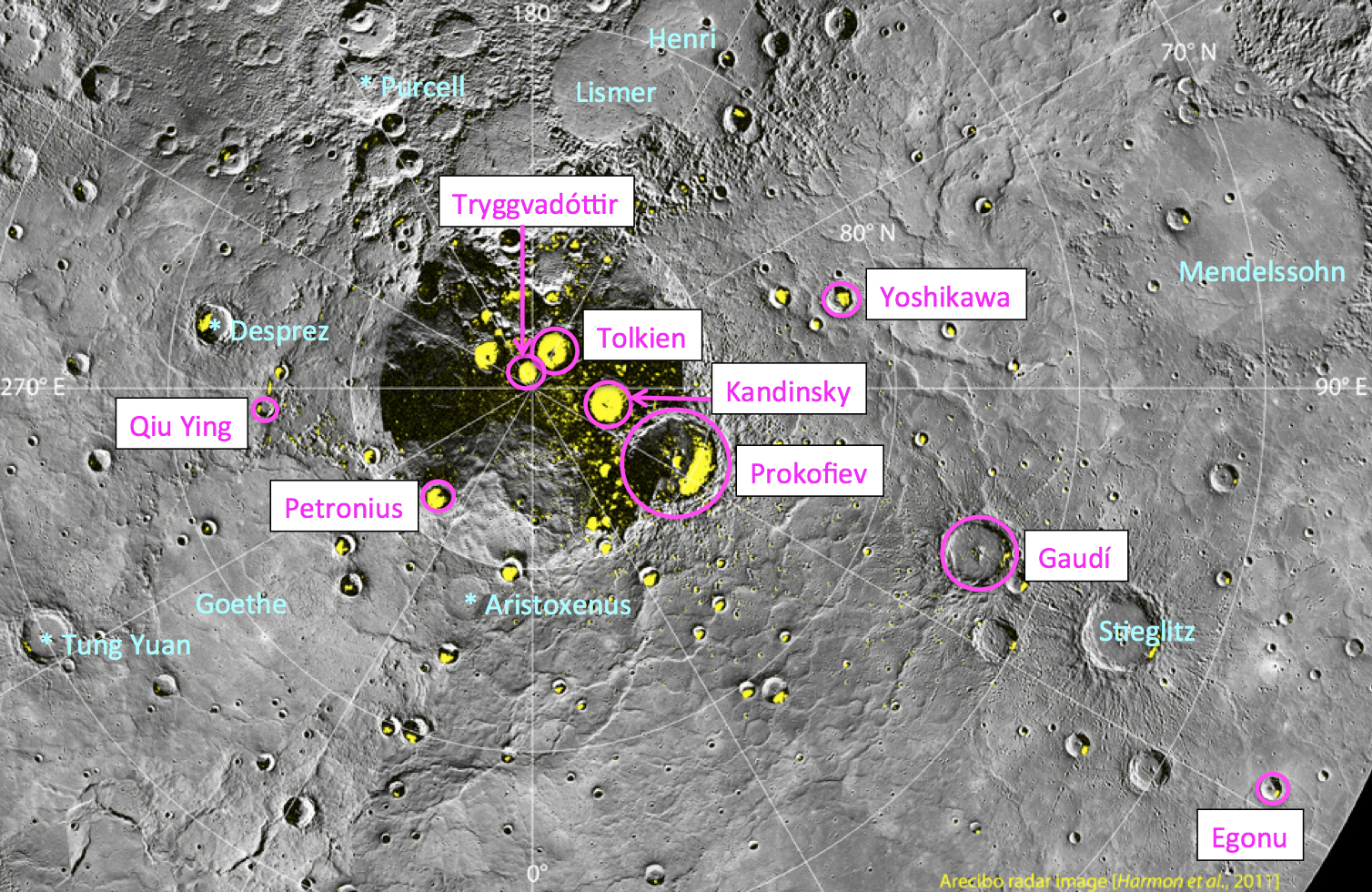
Researchers at
Agriculture would be possible with 2x10¹³-1015 kg of water covered by 5.65x10⁹m3 of carbon-rich hydrocarbons. Crops would provide food and oxygen, and consume the carbon dioxide we exhale. All human habitation and agriculture would be underground to avoid temperature extremes, ionizing radiation, and the loss of oxygen, water and carbon dioxide to the surface. Filtered light could be used for crops, but it is likely that rapidly growing crop varieties could be developed which would take advantage of the high light intensity and the long Mercury day, where sunrise to sunset lasts for 88 Earth days. X-ray spectrometry for Si, Mg, Al, S, Ca, Ti, Fe, Cl, Cr and Mn, gamma-ray spectrometry for K, Th and U and gamma-ray spectrometry for Al, Ca, S, Fe and Na from Mercury MESSENGER shows the following average composition of Mercury's soil compared to Earth:
| Planet\Element | O | Si | Mg | Al | S | Ca | Ti | Fe | Cl | Cr | Mn | Na | K | Th | U | C | N | H |
| Mercury (tens of cm depth) | 42.3 | 24.6 | 12.5 | 7.1 | 2.3 | 5.9 | .2 | 1.9 | < .2 | < .5 | < .5 | 2.9 | .1 | .00002 | .00001 | ? | ? | ? |
| Earth (continental crust) | 47 | 28 | 2.5 | 8 | .04 | 4 | .5 | 5 | .02 | .02 | .1 | 2 | 2 | .0007 | .0002 | .1 | .002 | .1 |
Several other aspects of Mercury make it a good prospect for a colony. One very important advantage is the high solar light intensity, which is stronger than on Earth by a factor of 10.6 at perihelion and 4.6 at aphelion. This strong light intensity would provide virtually unlimited power via electronic solar arrays, and the resulting vertical temperature gradients of ~200oC/m would provide even more unlimited power via thermal solar arrays. With such an unlimited and inexpensive power source, almost anything needed for survival could be produced. The gravity on Mercury is 38% that of Earth, which is strong enough to avoid the reduction in bone mass that occurs in very low gravity and weightless environments. There are no temperature variations over periods longer than the Mercury day (like Earth's seasons), which avoids the need for heating/cooling equipment within the 22+/-1oC underground rings mentioned above. This occurs because Mercury's orbit is synchronized with its rotation such that 0deg and 180deg longitudes always experience midnight and noon at perihelion whereas 90deg and 270deg longitudes always experience midnight and noon at aphelion. The rings would be about 5000km long, similar to the diameter of the planet. They would be only 20-60km wide because of horizontal temperature gradients of .035-.097oC/km. This results in a total area of about 40x5000=200,000km2 of 22+/-1oC temperature around each pole. The rings could also be extended hundreds of floors downwards, essentially by making underground skyscrapers. And the entire area between the rings and the poles could also be populated (albeit more sparsely) simply by using abundant solar power. Now, an underground existence may sound undesirable to many people. However, that fact is that most people spend 95% of their lives indoors, and from a quality-of-life perspective there is little difference between indoors above ground and indoors below ground. And the colony could still have natural areas, trees, flowers, parks, lakes, wild animals, etcetera. In fact it would probably need all of these things to maintain the ecosystem. The only difference from Earth is that they would be in man-made underground greenhouses instead of on the planet surface.
Mars automatically comes to mind when discussing planetary colonization, and manned missions to Mars have been the long term focus of US space exploration plans since 2004. But despite all the hype, Mars is really a poor prospect for colonization. The solar light intensity on Mars is .43 that of Earth, which makes solar power and agriculture much less practical than on Mercury. The gravity of Mars is 38% of Earth, essentially equal to Mercury. The magnetic field of Mars is .1% of Earth, and its atmosphere density is 2% that of Earth, so protection from ionizing radiation would require underground habitation, the same as on Mercury. The average equatorial surface temperature of Mars is about -45oC (-50oF), which would be the constant temperature underground. And of course the temperature gets much lower away from the equator. Such low temperatures can be withstood by machines such as the Spirit, Opportunity and Curiosity Mars rovers, but not by people. Human habitation of Mars would be problematic because of the very low temperatures, limited solar power capacity, and a biological history which precludes oil, gas and coal deposits. Human habitation would probably be impossible without nuclear power, and uranium mining and nuclear plants would be very challenging in an airless, cold enviroment. Also, concentrated uranium deposits are probably less common than on Earth because they depend on sedimentary and hydrothermal processes which are more prevalent on Earth. The other planets, moons and asteroids have even worse drawbacks than Mars.
Asteroid impacts of 5km diameter or greater occur roughly once every 10 million years, and those of 10km or greater occur roughly once every 100 million years. In the past 540 million years there have been 5 extinction events where more than 50% of the Earth's species were killed off, including the Permian-Triassic extinction where 90% of the species were lost. Most scientists think that some of these were caused by asteriod impacts. A well proven example is the Chicxulub impact which resulted from a 10km asteroid impact at the Cretaceous-Tertiary boundary 65 million years ago and caused the extinction of 70% of the Earth's species, including the dinosaurs. Even larger impacts have occured at earlier times, of which only a few are known because their impact craters get erased by the Earth's geological processes over time. It is thought that a 20km or larger asteroid would cause the extinction of all higher order animals and plants, leaving only microorganisms. While the likelihood of such an event is very small in any given year, it could happen at any time, and it is almost guaranteed to happen eventually.
Given the facts above, it appears that the focus of US space exploration plans should be shifted from Mars to Mercury. In particular, the US has already had four successful Mars rovers, so how about a Mercury rover mission. Such a mission could focus on a detailed analysis of the water ice, the dark material covering the water ice, and the soil, either on-site or by bringing samples back to Earth, as proposed by one scientist. Analysis of these materials would be critical for a Mercury colony, and it would also be of interest from a purely scientific standpoint. How deep are the water ice deposits? On-site echosounding measurements would provide a much better estimate than the existing measurements, which really just give a lower bound. What is the isotopic composition of the water ice, which would give clues about its origin? What other materials are mixed in with it? Would the water need to be purged of poisonous contaminants before it could be used for drinking or agriculture? Is the dark covering material made out of hydrocarbons as several scientists have suggested? How much of this material is there, and could it be used as a source of carbon for agriculture? What is the soil concentration of Carbon and Nitrogen, elements that could not be measured by MESSENGER's gamma-ray and X-ray spectrometers? What minerals are present, and are some of the elements critical for agriculture locked up in minerals which cannot be metabolized by plants? Perhaps it would be best to land the rover near a small crater with water deposits, so it could hide in the crater from the hot sun, but project solar cells or a mirror over the edge. Some good landing sites could probably be found among the large number of high resolution images taken by MESSENGER.
The main motivation for investigating Mercury is its potential for hosting a self-sustaining human colony, which would protect humanity from extinction in the event of a catastrophic asteroid impact. A second motivation is simply to increase our scientific understanding of the solar system. It is very unlikely that Mercury could ever be a practical source of minerals or energy to be transported back to Earth, or that Mercury would ever have any other Earth-serving economic value. But surely preservation of the human species and scientific curiosity are better motivations than economic benefit. Humans are part of a universe where time is measured in billions of years. We need to take a long term view, and consider the future of the human species in the next thousand, million and billion years, not just the next 10 or 100 years.
A Mercury colony would be a challenging and costly effort for sure. The voyage to Mercury might take 6.5 years like the MESSENGER trip because of the large velocity change involved, and the spacecraft would require heavy shielding against ionizing radiation. Much planning and preparation would be needed to ensure that the colony could get through the first weeks, months, and years, with little or no resupply from Earth. However, a Mercury colony appears to be a real possibilty using current technology, not a fantasy for the distant future. “People joke about it, but it’s not so crazy, really,” said David A. Paige, a professor of geology at U.C.L.A. involved with the water ice discovery. In fact, if we delay until the distant future, or even 50 years or so, such an effort probably will become impossible. This is because us humans will consume the Earth's non-renewable energy and mineral resources almost completely within the next 50-100 years, severely reducing our discretionary income for costly activities such as space travel. We should be pursuing a Mercury colony now, before it is too late.
Go back to my home page.